Custom Metric Components: When an Off-the-Shelf Part Isn’t Enough
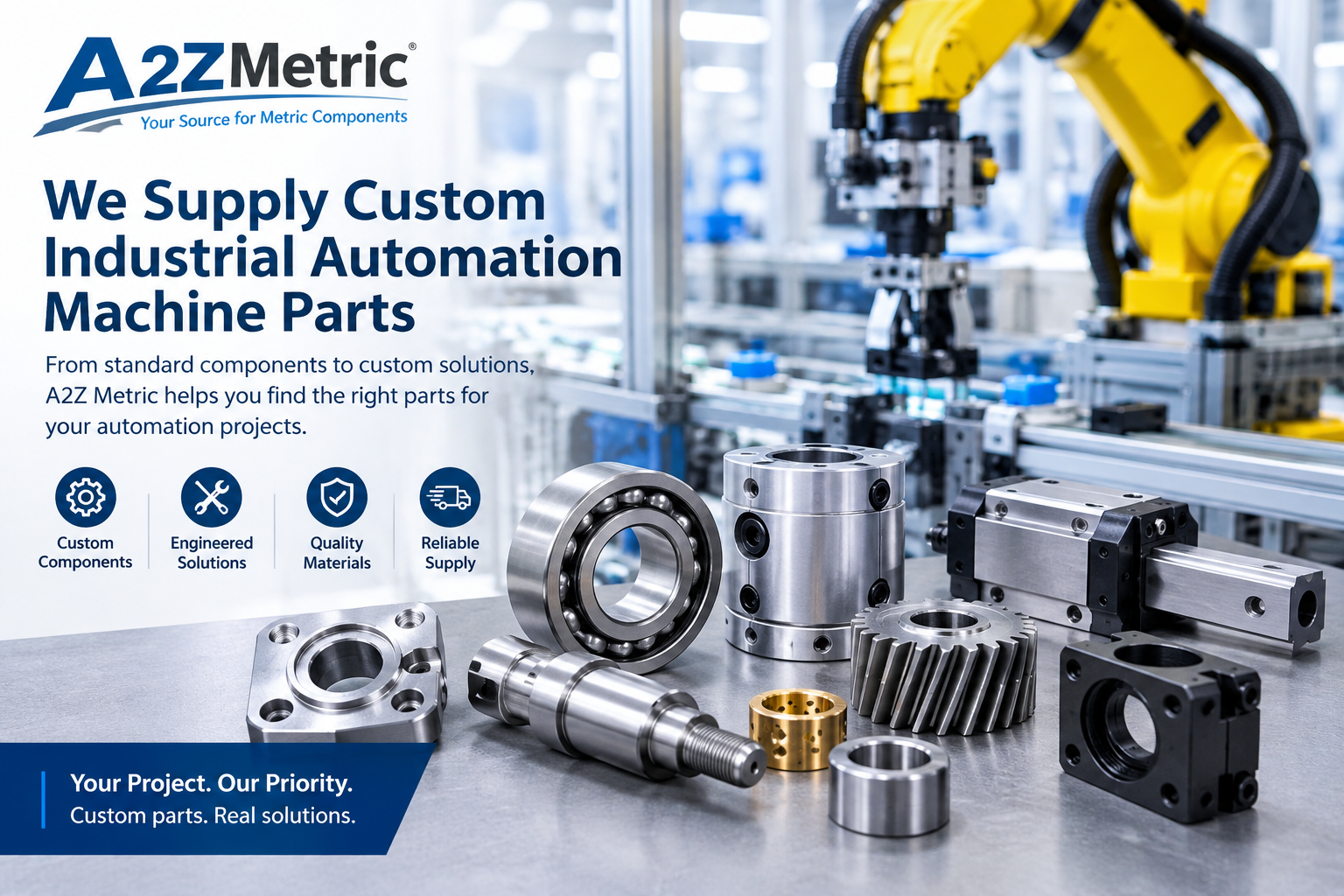
For many engineering and manufacturing applications, standard metric components are the fastest and most cost-effective solution. Bearings, bushings, gears, shafts, pulleys, couplings, and other machine components are available in a wide range of standard sizes and materials.
But what happens when the standard part is close—but not quite right?
A bore may be slightly too large or too small. A shaft may require a nonstandard length. A component may need to withstand corrosive environments. Perhaps the available material does not provide the required strength, or an existing component needs to be modified to fit a specialized assembly.
This is where custom metric components can provide a practical solution.
Instead of redesigning an entire machine around an off-the-shelf component, engineers can often specify a modified or fully custom part that meets the application's exact requirements. A2Z Metric can help source custom metric components and engineered modifications for applications where standard parts aren't enough.
When Should You Consider a Custom Metric Component?
The decision to use a custom component generally comes down to performance, fit, availability, and overall project cost.
If a standard component requires significant modification in-house—or forces you to redesign surrounding components—it may make more sense to source a custom part from the beginning.
Engineers should consider a custom metric component when:
- Standard dimensions don't fit the application
- A specific bore or shaft size is required
- The component requires a nonstandard length or diameter
- A different material is necessary
- The operating environment is especially demanding
- A component needs additional machining or modification
- Standard parts create excessive clearance or interference
- The component must integrate with an existing assembly
- Performance requirements exceed standard component specifications
- Redesigning the equipment would be more expensive than modifying the part
Custom sourcing can be particularly valuable when working with specialized machinery, automation equipment, robotics, production machinery, and replacement components for imported equipment.
Custom Bores for Precise Fit
One of the most common reasons to customize a metric component is the bore.
A standard bearing, bushing, pulley, gear, or other component may have the correct outside diameter and overall dimensions but come with the wrong bore size.
Rather than replacing multiple components or redesigning a shaft, a custom bore can provide the required fit.
Depending on the component, engineers may specify:
- Custom bore diameters
- Keyways
- Splines
- Tapered bores
- Stepped bores
- Special tolerances
- Custom bore depths
Proper bore sizing is especially important in rotating equipment. An incorrect fit can contribute to vibration, premature wear, slippage, or component failure.
When specifying a custom bore, engineers should consider the shaft diameter, required tolerance, load, rotational speed, installation method, and operating temperature.
Custom Dimensions
Sometimes the problem isn't the bore—it's the overall size of the component.
A standard metric component may be almost perfect but have a length, width, outside diameter, thickness, or mounting dimension that doesn't work with the existing equipment.
Custom dimensions can allow a component to fit into a constrained assembly without requiring extensive changes to surrounding parts.
For example, a custom component may be needed when:
- Space is limited
- Existing mounting locations cannot be moved
- A particular shaft length is required
- Clearance between components is critical
- A replacement part is no longer available
- The original equipment uses a proprietary dimension
For replacement applications, providing a drawing, sample, dimensions, or specifications can help a supplier determine the best custom solution.
Modified Components vs. Completely Custom Parts
Not every custom application requires a component to be manufactured from scratch.
In many cases, an existing standard component can be modified to meet the application's requirements. This can be a more economical option than producing a completely custom part.
Common modifications can include:
- Machining a bore
- Adding a keyway
- Cutting a component to length
- Adding mounting holes
- Changing hole patterns
- Modifying shoulders or steps
- Adding threads
- Changing surface finishes
- Adjusting dimensions
- Modifying material or coatings
The right approach depends on the component, quantity, required tolerances, and manufacturing process.
A supplier experienced with engineered modifications can help determine whether modifying a standard component or manufacturing a fully custom component makes the most sense.
When Stainless Steel Makes Sense
Material selection can be just as important as dimensions.
Standard carbon steel or other materials may work well in many applications, but some environments require additional corrosion resistance or specific mechanical properties.
Stainless steel metric components may be appropriate for applications involving:
- Moisture
- Washdown environments
- Corrosive chemicals
- Food-processing equipment
- Marine environments
- Outdoor equipment
- Clean manufacturing environments
Different stainless grades offer different properties, so engineers should avoid assuming that all stainless steel performs the same way.
The appropriate material depends on corrosion exposure, temperature, loading, wear, strength requirements, and other operating conditions.
Other Engineered Modifications
Custom metric components aren't limited to dimensions and materials.
Depending on the component, engineers may also require specialized modifications such as coatings, heat treatments, surface finishes, threads, mounting configurations, or special tolerances.
For example, an application may require a component with:
Special tolerances: Precision applications may require tighter dimensional tolerances than a standard component provides.
Surface treatments: Coatings or treatments may improve wear resistance, corrosion resistance, or surface performance.
Heat treatment: Certain applications may benefit from increased hardness or other mechanical properties.
Special threads: Metric, fine, left-hand, or other specialized threads may be necessary for proper installation.
Custom mounting features: Additional holes, slots, keyways, or other features can allow a component to integrate with existing equipment.
These modifications can help engineers solve a specific design problem without compromising the rest of the machine.
Don't Forget About Minimum Order Quantities
One consideration when sourcing custom components is quantity.
Custom manufacturing can involve tooling, programming, setup, engineering, or other costs that may make very small quantities more expensive on a per-piece basis.
However, that doesn't necessarily mean custom sourcing isn't practical for smaller projects.
For prototypes, repairs, replacement components, or specialized equipment, the cost of modifying or sourcing a custom component should be compared with the cost of redesigning the machine or manufacturing the component in-house.
An experienced supplier can help identify the most practical sourcing option based on the required quantity and specifications.
What Information Should Engineers Provide?
The more information available, the easier it is to determine whether a standard, modified, or custom component is appropriate.
When requesting a custom metric component, consider providing:
- Component type
- Required dimensions
- Bore diameter
- Shaft dimensions
- Material requirements
- Tolerances
- Load requirements
- Operating speed
- Temperature range
- Environmental conditions
- Surface finish
- Coating requirements
- Quantity
- Application or equipment information
- Existing drawings or CAD files
Even if you don't have a complete engineering drawing, photographs, measurements, samples, and existing part numbers can provide useful starting information.
A2Z Metric Can Help Source Custom Metric Components
Finding the right custom metric component doesn't always mean starting the manufacturing process from scratch.
A2Z Metric can help source custom metric products and engineered modifications for applications that don't fit standard catalog specifications. Whether you need a custom bore, nonstandard dimensions, modified components, stainless steel construction, or another specialized requirement, providing the specifications can help identify the appropriate sourcing solution.
This can be particularly helpful when you're replacing an obsolete component, working with imported machinery, dealing with limited space, or trying to avoid an expensive equipment redesign.
Instead of settling for a component that is "close enough," engineers can explore whether a custom or modified metric component provides a better fit for the application.
Conclusion
Off-the-shelf metric components are an excellent choice for many applications, but they're not always the best answer.
When a standard component has the wrong bore, dimensions, material, tolerance, or configuration, a custom solution can provide the fit and performance required without forcing unnecessary changes elsewhere in the machine.
From custom metric bores and dimensions to stainless steel components and specialized engineering modifications, the right solution depends on the application's requirements.
If your project requires something beyond the standard catalog, A2Z Metric can help source custom metric components and engineered solutions tailored to your specifications.
Frequently Asked Questions
1. What are custom metric components?
Custom metric components are machine parts manufactured or modified to meet specifications that aren't available in standard metric products. They can include custom dimensions, bores, materials, tolerances, mounting features, and other modifications.
2. When should I choose a custom component instead of a standard part?
Consider a custom component when a standard part doesn't provide the required fit, dimensions, material, tolerance, or performance. Custom sourcing may also be worthwhile when redesigning surrounding equipment would be more expensive than modifying the component.
3. Can A2Z Metric source components with custom bores?
Yes. A2Z Metric can help source metric components with custom bore requirements, depending on the component and specifications.
4. Can metric components be made from stainless steel?
Many types of metric components can be sourced in stainless steel or other specialized materials. The appropriate material depends on the application's corrosion, strength, temperature, wear, and environmental requirements.
5. Can an existing standard component be modified?
In many cases, yes. Standard components can potentially be modified with features such as custom bores, keyways, mounting holes, threads, shortened dimensions, or other machining operations.
6. What information do I need to request a custom component?
Start with the component type, dimensions, bore or shaft requirements, material, quantity, tolerances, and application. Drawings, CAD files, photographs, samples, and existing part numbers can also be helpful.
7. Are custom metric components more expensive?
They can have a higher unit cost than standard components, particularly at low quantities. However, custom sourcing can sometimes be more economical than redesigning equipment or performing extensive modifications in-house.
8. Can A2Z Metric help if I don't have a complete drawing?
Yes. Providing as much information as possible—including measurements, photographs, samples, existing part numbers, and application details—can help A2Z Metric determine potential sourcing options.
9. Does A2Z Metric only supply standard metric components?
No. In addition to standard metric components, A2Z Metric can help source custom products and engineered modifications for applications requiring specifications beyond standard catalog offerings.