Screw Jack vs. Linear Actuator: Which Is Better for Your Application?
Screw Jack vs. Linear Actuator: Which Is Better for Your Application?
When a machine needs to lift, push, pull, position, or move a load in a straight line, choosing the right motion component is critical. Two common solutions are screw jacks and linear actuators. While both can provide linear motion, they are designed for different types of applications and operating requirements.
So, when comparing a screw jack vs. linear actuator, which one is right for your machine?
The answer depends on several factors, including load capacity, speed, duty cycle, positioning requirements, available space, power source, and whether the load needs to remain securely in position.
At A2Z Metric Components, we supply both screw jacks and linear actuators for industrial machinery, automation, OEM equipment, and replacement applications. Our team can help identify the appropriate component based on your application requirements.
What Is a Screw Jack?
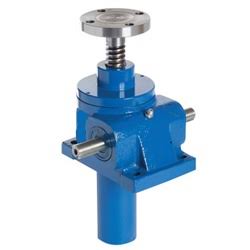
A screw jack is a mechanical lifting and positioning device that converts rotary motion into linear motion. Screw jacks are commonly used to raise, lower, push, pull, tilt, or precisely position machinery and loads.
Machine screw jacks typically use a worm gear and lifting screw. Depending on the design and gear ratio, some screw jacks can be self-locking, allowing them to hold a load in position without continuous motor operation.
Screw jacks are often selected for applications where high load capacity, controlled movement, mechanical positioning, and load holding are important.
A2Z Metric supplies several types of screw jack solutions, including machine screw jacks, miniature screw jacks, stainless steel screw jacks, metric screw jacks, and motorized configurations. Available capacities and configurations vary by product and application.
What Is a Linear Actuator?
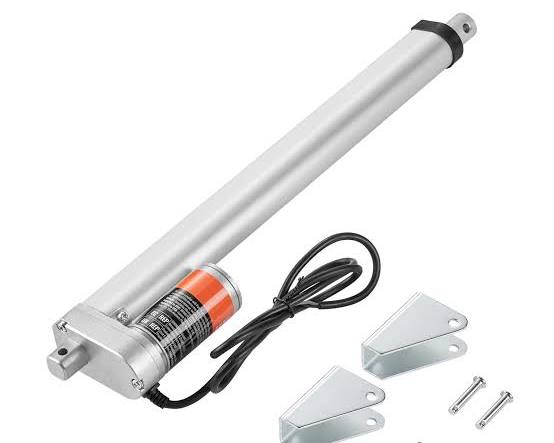
A linear actuator is a device designed to create controlled linear movement. Electric linear actuators commonly use an electric motor combined with a screw mechanism to extend and retract a rod or other moving component.
Linear actuators can be a convenient choice when an application requires automated push-and-pull movement without the need for a separate motor, gearbox, and mechanical transmission arrangement.
Depending on the design, linear actuators can include features such as limit switches, position feedback, different mounting configurations, and various voltage options.
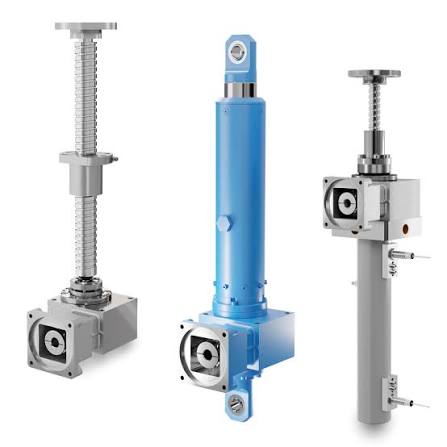
For example, A2Z Metric offers electric cylinder actuators designed for lifting and positioning applications, as well as other actuator configurations for industrial equipment.
Screw Jack vs. Linear Actuator: Key Differences
Although screw jacks and linear actuators can perform similar functions, there are several important differences to consider.
1. Load Capacity
Screw jacks are often used for heavier-duty lifting and positioning applications. Depending on the model, screw jack systems can accommodate substantial loads and can be configured as single, tandem, or multiple-jack systems.
A2Z Metric's screw jack offerings include models ranging from smaller applications to heavy-duty systems, with some machine screw jack configurations rated from 2 to 250 tons.
Linear actuators can also handle significant loads, but their capacity depends heavily on the actuator design, motor, screw type, stroke, speed, and duty cycle.
If your application involves lifting a particularly heavy load, a screw jack system may provide the mechanical arrangement and capacity you need.
2. Speed
If speed is a major consideration, the application should be carefully evaluated.
Traditional machine screw jacks are generally suited to controlled, slower linear movement. Ball screw jack configurations can provide significantly higher travel speeds and efficiency.
Electric linear actuators can also provide relatively fast and repeatable movement, depending on the model.
For example, A2Z Metric offers ball screw ComDRIVE systems with travel speeds up to 55.5 inches per minute, while its electric cylinder offerings can reach considerably higher travel speeds depending on the configuration.
The fastest option isn't necessarily the best option. The required speed should always be evaluated alongside load, duty cycle, positioning accuracy, and expected service life.
3. Load Holding
Load holding can be an important consideration in lifting applications.
Some machine screw jacks are self-locking, depending on their screw design and gear ratio. This can help prevent a load from back-driving under appropriate operating conditions.
However, not every screw jack or actuator is self-locking. Ball screw systems, for example, may require a brake motor or another external locking mechanism to hold position.
When a load must remain safely positioned, engineers should evaluate the manufacturer's specifications rather than assuming an actuator or screw jack will automatically hold the load.
4. Installation and System Design
A linear actuator can offer a relatively straightforward installation because the motor and linear mechanism may be integrated into one unit.
Screw jack systems, on the other hand, can be more modular. Multiple screw jacks can be connected using shafts, couplings, gearboxes, and other components to create synchronized lifting or positioning systems.
This flexibility can be especially useful in machinery that needs to lift a large platform or unevenly distributed load from multiple points.
5. Precision and Positioning
Both screw jacks and linear actuators can provide controlled positioning, but the required level of precision will determine which technology and configuration make sense.
Screw jacks are commonly used for machine adjustment, lifting platforms, conveyors, positioning equipment, and other applications where controlled mechanical movement is required.
Electric actuators can also provide precise positioning, particularly when paired with appropriate controls and feedback systems.
The important thing is to specify the actual requirements of your application, including travel distance, repeatability, speed, load, and allowable positioning error.
When Should You Choose a Screw Jack?
A screw jack may be a good fit when your application requires:
- Heavy lifting or positioning
- Mechanical load holding
- Slow, controlled movement
- Multiple synchronized lifting points
- Push, pull, or lifting force
- Precise mechanical positioning
- Integration with motors, gearboxes, shafts, or couplings
- A custom or engineered lifting system
Screw jack systems are commonly found in manufacturing equipment, conveyors, packaging machinery, steel machinery, food processing equipment, and other industrial applications.
When Should You Choose a Linear Actuator?
A linear actuator may be a good fit when your application requires:
- Automated push-and-pull movement
- A compact integrated solution
- Electric operation
- Frequent extension and retraction
- Straightforward mounting
- Limit switches or position feedback
- Moderate loads and controlled travel
- Integration with automated machinery
The appropriate actuator will depend on the required force, stroke length, speed, voltage, duty cycle, mounting arrangement, and environmental conditions.
Don't Choose by Name Alone
One of the most common mistakes when selecting a machine component is choosing based only on the name of the part.
Instead, start with the application.
Before selecting a screw jack or linear actuator, determine:
- What is the total load?
- How far does the load need to move?
- How quickly must it move?
- How often will it operate?
- Does the load need to remain locked in position?
- What power source is available?
- What mounting configuration is required?
- What environmental conditions will it operate in?
- Does the application require metric dimensions?
- Are there space or dimensional limitations?
These details can make a significant difference in selecting the correct component.
A2Z Metric Can Supply Your Screw Jacks and Linear Actuators
Finding the right machine component isn't always as simple as selecting a part from a catalog. OEM machinery, replacement applications, and custom equipment can have unique load, dimensional, and performance requirements.
A2Z Metric Components supplies screw jacks, linear actuators, and other machine components for industrial, OEM, automation, and replacement applications. A2Z Metric specializes in metric and imperial components and can also help source application-specific and hard-to-find components.
If you're unsure whether a screw jack or linear actuator is right for your application, providing the load, travel, speed, mounting requirements, dimensions, and operating environment can help identify the appropriate solution.
Need help selecting a screw jack or linear actuator? Contact A2Z Metric Components to discuss your application and find the right machine component for your equipment.
Frequently Asked Questions
What is the difference between a screw jack and a linear actuator?
A screw jack is a mechanical device that converts rotary input into linear movement, commonly for lifting and positioning. A linear actuator is a broader category of devices designed to produce linear movement and may incorporate an electric motor, screw mechanism, controls, and other components.
Are screw jacks stronger than linear actuators?
Not necessarily. Load capacity depends on the specific design and model. Screw jacks are available in configurations designed for very heavy loads, while linear actuators are available across a wide range of capacities. The application specifications should determine the appropriate component.
Are screw jacks self-locking?
Some machine screw jacks are self-locking, depending on the screw and gear configuration. However, not all screw jacks are self-locking. Ball screw systems, for example, may require an external locking mechanism or brake motor.
Can a screw jack be motorized?
Yes. Screw jacks can be driven by electric motors and incorporated into larger mechanical systems. Motorized screw jack configurations can also be connected in multiple-jack systems for synchronized movement.
What should I consider when selecting a linear actuator?
Consider load capacity, stroke length, travel speed, duty cycle, voltage, mounting configuration, environmental conditions, feedback requirements, and whether the actuator needs to hold a load when power is removed.
Does A2Z Metric supply both screw jacks and linear actuators?
Yes. A2Z Metric Components supplies both screw jacks and linear actuators, along with a broad range of metric and imperial machine, automation, power transmission, and linear motion components.
Can A2Z Metric help me choose the right component?
Yes. A2Z Metric encourages customers to provide application information, drawings, dimensions, part numbers, or other requirements when a standard catalog component isn't enough. The company offers sourcing and engineering support for application-specific and hard-to-find components.
Final Thoughts
Choosing between a screw jack vs. linear actuator comes down to the requirements of your equipment—not simply which component is more powerful or more convenient.
For heavy-duty lifting, mechanical positioning, synchronized systems, and applications requiring specific load-holding characteristics, a screw jack may be appropriate. For integrated electric push-and-pull movement and automated applications, a linear actuator may be the better fit.
If you're designing new equipment, replacing an existing component, or trying to identify the right part for a machine repair, A2Z Metric Components can help you find the right screw jack, linear actuator, or other machine component for your application.