ENGINEER PROBLEM OF THE WEEK: Need to Transmit Rotation Between Two Shafts That Aren’t Perfectly Aligned?
ENGINEER PROBLEM OF THE WEEK: Need to Transmit Rotation Between Two Shafts That Aren’t Perfectly Aligned?
Here’s why a universal joint may be the answer.
In mechanical design, perfectly aligned shafts are ideal—but they aren’t always practical. Space limitations, moving components, changes in machine geometry, or simple installation constraints can leave two shafts operating at an angle to one another.
So, how do you reliably transfer rotary motion from one shaft to another when their centerlines don’t line up?
One solution is a universal joint, or U-joint.
Universal joints are designed to transmit torque between shafts while accommodating angular misalignment. They’re used across automation, machinery, material handling, automotive systems, packaging equipment, and other applications where rotary motion needs to travel through an offset or angled connection.
What Is a Universal Joint?
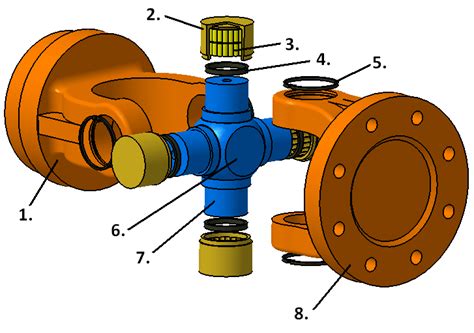
A universal joint connects two shafts using a cross-shaped intermediate component and two yokes. As the input shaft rotates, the joint transfers that rotational motion to the output shaft—even though the two shafts are not perfectly collinear.
The result is a compact mechanical connection that can accommodate angular movement without requiring the shafts themselves to be perfectly aligned.
![Universal joint assembly showing the cross and yokes]
A typical U-joint contains several precision-machined components, including the yokes, cross, bearing elements, and connection features that attach the joint to the shafts.
For applications requiring higher precision, needle-roller universal joints can provide very low backlash and high accuracy. A2Z Metric Components offers precision universal joints designed for applications involving high torque and high-speed rotation. Their standard precision single universal joints are available in metric sizes and can operate at angles up to 45°, depending on the model and application.
Why Would an Engineer Use a Universal Joint?
The biggest reason is simple: shaft alignment isn't always perfect—or even possible.
Imagine a machine where a motor sits on one side of a frame while the driven mechanism is positioned several inches away and slightly higher or lower. A rigid shaft connection would require the two components to be precisely positioned on the same centerline.
A universal joint provides another option.
Instead of redesigning the entire machine around perfect shaft alignment, an engineer can use a U-joint to accommodate the angle between the shafts.
This can be particularly useful when:
- Shafts are positioned at an angle.
- Equipment moves during operation.
- Space is limited.
- A compact transmission solution is needed.
- Components need to be connected without extensive structural modifications.
- Rotary motion must pass through a changing machine geometry.
![Technical illustration of a universal joint and its internal components]
How Does a U-Joint Work?
The basic principle is straightforward.
The input shaft rotates one yoke. That yoke is connected to a cross, which transfers the motion to the second yoke and ultimately to the output shaft.
Because the cross allows the yokes to articulate relative to one another, the two shafts can operate at an angle.
However, there is an important engineering consideration: a single universal joint does not produce perfectly uniform output speed when operating at an angle.
As the joint rotates, the output shaft's instantaneous angular velocity varies relative to the input shaft. This effect becomes more significant as the operating angle increases.
For applications where uniform velocity is important, engineers may use two universal joints arranged appropriately to help compensate for this variation.
That's why selecting the correct joint isn't simply a matter of finding one that "fits."
What Should Engineers Consider When Selecting a Universal Joint?
Before specifying a universal joint, consider the complete operating environment.
1. Shaft Diameter
Start with the shaft dimensions. Metric universal joints are available in a range of bore sizes, making it important to match the joint to the shaft or determine whether a custom bore is required.
A2Z Metric Components provides metric universal joints in multiple sizes and also lists custom bore sizes as an available option.
2. Operating Angle
Determine the maximum angle between the shafts during operation—not just during installation.
A joint that works at a small static angle may not be appropriate if the machine moves through a much larger range.
A2Z Metric Components lists precision universal joints with maximum operating angles of up to 45° for its standard precision designs. Certain specialized configurations have different operating limits, so the application-specific specification should always be checked before selection.
3. Torque
How much torque will the joint need to transmit?
Torque requirements should be considered alongside operating speed and angle. A joint's permissible torque can change depending on rotational speed and configuration, so selecting purely by bore size can lead to an undersized component.
4. Speed
High-speed applications require particular attention to joint design, balance, tolerances, lubrication, and operating angle.
For example, A2Z Metric Components' precision single universal joints are specified for high-speed applications up to 800 rpm, depending on the particular size and configuration.
5. Environment
Will the joint be exposed to moisture, chemicals, washdown conditions, dust, or corrosion?
Material selection can make a major difference. A2Z Metric Components offers stainless-steel universal-joint options in addition to steel configurations.
Universal Joints vs. Telescopic Universal Joints
Sometimes an angular connection isn't the only challenge.
What if the distance between the two shafts also changes?
That's where a telescopic universal joint can become useful.
A telescopic design combines angular articulation with an adjustable shaft length. This can be beneficial in machinery where components move relative to one another or where installation requires some adjustment in the shaft length.
A2Z Metric Components offers telescopic universal joints in several configurations, including polymer, needle-roller, and stainless-steel options. Its published specifications include metric bore sizes and adjustable minimum-to-maximum lengths.
How A2Z Metric Components Can Source the Right Parts for You
Finding the right universal joint can involve more than identifying a part number.
You may know your shaft diameter and torque requirement, but still need help determining the correct joint style, material, operating angle, or connection configuration.
That's where A2Z Metric Components can help.
Instead of forcing an application into a generic off-the-shelf component, A2Z Metric Components can help you identify an appropriate metric component based on your engineering requirements.
Depending on the application, available options can include:
- Precision universal joints
- Single and double universal joints
- Needle-roller universal joints
- Telescopic universal joints
- Stainless-steel universal joints
- Optional keyways
- Custom bore sizes
- Spline shafts and related components
A2Z Metric Components also offers spline shafts in C45 steel and 1.4301 stainless steel, with standard lengths and additional lengths available by request. This can be useful when a complete rotary transmission solution requires more than the U-joint alone.
The best approach is to provide your application information—shaft sizes, operating angle, torque, RPM, required length, environment, and any dimensional constraints—and have the component matched to those requirements.
Need help sourcing a universal joint?
Visit A2Z Metric Components and request a quote or contact their team about your application.
The Engineer's Takeaway
When two shafts aren't perfectly aligned, don't automatically assume the machine needs a complicated redesign.
A universal joint can provide a relatively compact and practical method for transmitting rotary motion across an angle.
The key is selecting the joint based on the entire application—not just the shaft diameter.
Consider the angle, torque, RPM, shaft dimensions, environment, required precision, and whether the shaft length changes during operation. For demanding applications, details such as backlash, bearing design, materials, and permissible operating limits become equally important.
And if you're not sure which configuration fits your application, that's exactly when working with a component specialist can save engineering time.
Problem: Two shafts aren't perfectly aligned.
Potential solution: A universal joint.
Engineering priority: Select the right joint for the actual operating conditions.
Frequently Asked Questions
1. What is a universal joint used for?
A universal joint is used to transmit rotary motion and torque between two shafts that operate at an angle to one another.
2. Can a universal joint handle shaft misalignment?
Yes. Universal joints are specifically designed to accommodate angular misalignment between connected shafts. The allowable angle depends on the specific joint and application.
3. What is the difference between a single and double universal joint?
A single U-joint connects two shafts through one joint. A double arrangement uses two joints and can be used when the application requires improved motion characteristics or greater flexibility in the shaft arrangement.
4. What is a telescopic universal joint?
A telescopic universal joint combines angular articulation with an adjustable shaft section, allowing it to accommodate changes in the distance between connected components.
5. Does A2Z Metric Components offer custom universal joints?
A2Z Metric Components lists options including custom bore sizes and optional keyways for its universal-joint product range. Specific customization should be confirmed for the application.
6. What information should I provide when sourcing a universal joint?
Provide shaft diameters, required bore dimensions, operating angle, torque, RPM, shaft spacing or length, environment, material requirements, and any space or mounting restrictions.
7. Are universal joints suitable for high-speed applications?
Some precision universal joints are designed for high-speed operation, but permissible speed depends on the specific size, angle, torque, and configuration. Always use the manufacturer's specifications for final selection.
8. Does A2Z Metric Components offer stainless-steel options?
Yes. A2Z Metric Components lists stainless-steel universal-joint configurations, including 1.4301 stainless steel options.