How to Choose the Right Gear for Your Industrial Application
Gears are at the heart of countless industrial machines and power-transmission systems. They transfer motion, control speed, increase or decrease torque, and, depending on the configuration, change the direction of rotation. But with several gear types available, choosing the right one for a particular application can be challenging.
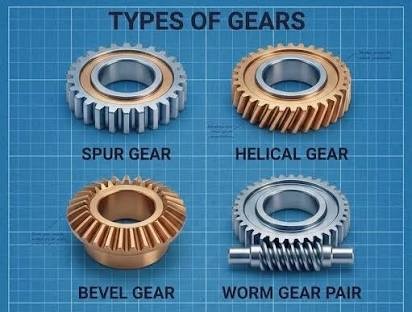
The four common gear types discussed here—spur gears, helical gears, bevel gears, and worm gear pairs—each offer different advantages. The right choice depends on factors such as shaft arrangement, speed, torque, load, efficiency, noise, available space, operating environment, and required gear ratio.
Understanding these differences before specifying a gear can help improve equipment performance, reduce maintenance, and increase service life.
Start With the Application, Not the Gear
One of the most important steps in gear selection is to begin with the requirements of the machine rather than choosing a gear based simply on familiarity or cost.
Before selecting a gear, consider:
- What speed will the gear operate at?
- How much torque must it transmit?
- What is the expected load?
- Are the shafts parallel, intersecting, or positioned at 90 degrees?
- Is high efficiency important?
- Is noise a concern?
- How much space is available?
- What gear ratio is required?
- How frequently will the equipment operate?
- Will the gear be exposed to dust, moisture, chemicals, temperature extremes, or other demanding conditions?
Once these requirements are understood, the appropriate gear type becomes much easier to identify.
Spur Gears: Simple, Efficient, and Cost-Effective
Spur gears are one of the simplest and most widely used gear designs. Their teeth are straight and parallel to the shaft, and they are generally used to transmit motion between parallel shafts. Their relatively straightforward design makes them economical and easy to manufacture and maintain.
Spur gears can be a good choice when an application requires a straightforward power-transmission solution without the additional complexity of angled teeth.
Common applications can include:
- Conveyors
- Material-handling equipment
- Packaging machinery
- Pumps and other industrial equipment
- Machine tools
- General mechanical drives
One consideration is noise. Because the teeth engage relatively abruptly, spur gears can generate more noise and vibration at higher speeds than helical gears.
Choose a spur gear when: simplicity, cost, efficiency, and parallel-shaft operation are important and operating noise is not a primary concern.
Helical Gears: Smooth and Quiet Power Transmission
Helical gears have teeth cut at an angle relative to the gear axis. This angled tooth design allows the teeth to engage progressively rather than all at once, which generally results in smoother and quieter operation. Helical gears can also provide strong load-carrying capability and are widely used in industrial power-transmission applications.
Compared with spur gears, helical gears can be particularly attractive for applications involving higher speeds, heavier loads, or situations where noise and vibration need to be minimized.
Typical applications include:
- Industrial gearboxes
- Conveyors
- Pumps
- Compressors
- Production machinery
- Material-handling systems
- Automotive and heavy equipment transmissions
One factor engineers must consider is that the angled teeth create axial thrust, which means the supporting bearings and overall system design need to accommodate the additional force.
Choose a helical gear when: smooth operation, reduced noise, higher load capacity, and efficient power transmission are important considerations.
Bevel Gears: When You Need to Change Shaft Direction
Sometimes the primary challenge isn't speed or torque—it's the physical layout of the machine. If power needs to be transferred between shafts that intersect, particularly at approximately 90 degrees, a bevel gear may be the appropriate solution.
Bevel gears have teeth arranged on a conical surface and are designed to transmit motion between intersecting shafts. They are commonly used in right-angle drives and other applications where the direction of rotational power needs to change.
Bevel gears are available in different configurations, including straight and spiral bevel designs. The specific design can affect operating characteristics such as smoothness, noise, and load capability.
Applications can include:
- Right-angle drives
- Industrial machinery
- Conveyors
- Automotive differentials
- Machine tools
- Material-handling equipment
When specifying a bevel gear, shaft angle, gear ratio, torque, speed, tooth configuration, and available space are all important factors.
Choose a bevel gear when: the application requires power transmission between intersecting shafts or a change in the direction of rotation.
Worm Gear Pairs: High Reduction in a Compact Package
A worm gear pair consists of a worm and a mating worm wheel. The worm resembles a screw and engages with the teeth of the worm wheel. Unlike spur and helical gears, worm gear arrangements use sliding contact and are commonly selected when a substantial speed reduction is required in a compact arrangement.
One of the major advantages of worm gearing is the ability to achieve relatively high reduction ratios in a single stage. Depending on the specific design and operating conditions, some worm gear arrangements can also provide resistance to back-driving or self-locking characteristics.
However, worm gears generally have greater sliding action than spur or helical gears, which can result in more heat generation and lower efficiency. Lubrication, materials, operating speed, and duty cycle therefore become particularly important considerations.
Worm gear pairs are commonly found in:
- Conveyors
- Lifts and hoists
- Positioning equipment
- Material-handling systems
- Industrial actuators
- Packaging machinery
- Machine drives requiring significant speed reduction
Choose a worm gear pair when: high reduction, compact design, and specific back-driving or holding characteristics are important to the application.
Comparing the Four Gear Types
A quick way to narrow down your selection is to look at the fundamental requirements of your machine.
Spur gear: Best suited to straightforward power transmission between parallel shafts. It offers a simple, economical design and high efficiency but can be noisier at higher speeds.
Helical gear: A strong option for smooth, quiet, and higher-load applications involving parallel shafts. The angled teeth provide gradual engagement but introduce axial thrust.
Bevel gear: Ideal when the machine requires power to be transmitted between intersecting shafts, particularly when a right-angle arrangement is needed.
Worm gear pair: Well suited for applications requiring substantial speed reduction in a compact package. Efficiency and heat generation should be carefully evaluated for continuous-duty applications.
There isn't one universally "best" gear. The best gear is the one that matches the mechanical requirements of the equipment.
Don't Overlook the Gear Specifications
Choosing the gear type is only the first step. The gear must also be correctly specified for the application.
Important specifications can include:
- Number of teeth
- Module or diametral pitch
- Pressure angle
- Pitch diameter
- Outside diameter
- Face width
- Bore size
- Keyway requirements
- Gear ratio
- Helix angle, where applicable
- Material
- Heat treatment
- Surface finish
- Accuracy or quality requirements
- Shaft configuration
- Operating speed and torque
For replacement gears, providing the existing gear's dimensions, drawings, photographs, part numbers, or equipment information can also help identify the appropriate replacement.
A2Z Metric Components Can Help Source the Right Gear
Finding the correct industrial gear isn't always as simple as selecting a product from a catalog. Applications may require specific dimensions, materials, configurations, or modifications that aren't available as an off-the-shelf component.
A2Z Metric Components can help source the gear your application requires, including spur gears, helical gears, bevel gears, and worm gear pairs.
Whether you're replacing an existing gear, designing new equipment, or trying to identify a hard-to-find component, providing as much information as possible can help streamline the sourcing process. A2Z Metric Components can work from specifications, drawings, part numbers, dimensions, or other available information to help identify a suitable gear solution.
This can be particularly valuable for maintenance teams and engineers who need to replace a component without redesigning an entire system.
The Right Gear Starts With the Right Questions
Selecting an industrial gear doesn't have to be complicated, but it does require looking beyond the gear's appearance. Shaft orientation, speed, torque, load, reduction ratio, noise, efficiency, space, and operating environment all play a role in determining the right solution.
For simple parallel-shaft applications, a spur gear may provide an economical and efficient solution. When smoother and quieter operation is needed, a helical gear may be a better choice. If the machine requires a change in shaft direction, bevel gearing can provide the necessary right-angle power transmission. And when a high reduction ratio is needed in a compact arrangement, a worm gear pair may be the right fit.
The key is to match the gear to the application—not the other way around.
Need help sourcing an industrial gear? A2Z Metric Components can help. Whether you need a spur gear, helical gear, bevel gear, or worm gear pair, contact A2Z Metric Components with your application requirements, dimensions, or existing part information. Our team can help you source the components needed to keep your equipment operating reliably.